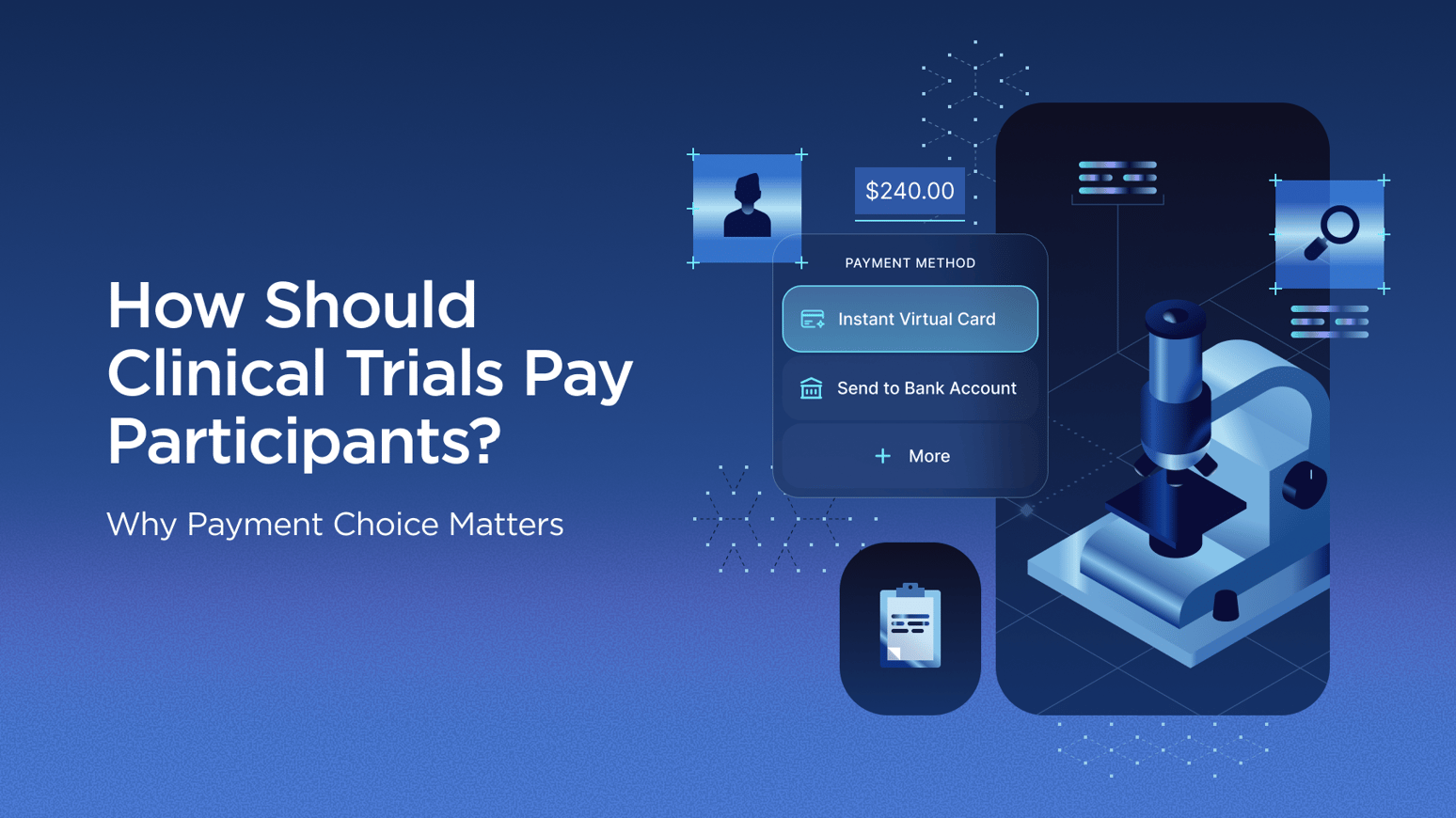
The evolution of medicine depends on clinical trials.
Every new treatment, therapy and medical breakthrough relies on people being willing to participate in research. But enrolling qualified participants is only the beginning. Research organizations also need to keep them engaged throughout the study.
That remains a significant challenge. Research published by Scientific Research Publishing identifies recruitment and retention as critical to clinical trial success and points to time commitments, transportation, long commutes and other participant burdens as barriers.
For participants, staying in a clinical trial can come at a cost.
Travel, parking, meals, childcare and time away from work can create financial pressure as visits add up. Compensation and reimbursement can help offset that burden, but how those payments are delivered also shapes the experience.
As organizations look for new ways to support participation and retention, participant compensation deserves a closer look.
The Participant Experience Extends Beyond the Study Visit
A clinical trial does not begin and end when a participant leaves the research site.
Participants may spend their own money getting to appointments or arranging for responsibilities at home. The National Institutes of Health distinguishes reimbursement for expenses such as travel and parking from compensation for a participant’s time and effort. Its guidance also says compensation should reflect the time, effort and inconvenience associated with participation.
Compensation is not simply an administrative process. It is part of the participant experience.
Research increasingly illustrates why that matters. A 2026 study published in JNCI Cancer Spectrum evaluated reimbursement for women with breast cancer participating in a clinical trial. Participants used the funds for transportation, food, caregiver expenses and out-of-pocket medical costs associated with trial visits. The study found an 85% retention rate in the reimbursement pilot, and interviewed participants indicated that reimbursement affected retention more than recruitment.
The researchers concluded that reimbursement was feasible, suggested decreases in financial toxicity, and showed promise as an approach to improving trial retention. Removing financial friction will not solve every retention challenge. But it can remove one barrier research organizations have the power to address.
The Challenge is Bigger than Making a Payment
Recognizing compensation as part of the participant experience raises an important question: How can research organizations simplify payments for participants without creating more work for research teams?
A single study may involve stipend payments and reimbursements across repeated visits and different participant needs. At the same time, research teams need appropriate payment controls, compliance, visibility, and information for reconciliation.
Standardizing every participant around one payment method may simplify one part of the process, but it does not necessarily create the best user experience.
Participants have different financial preferences. One may prefer a bank transfer. Another may prefer a card. Research organizations also operate within different clinical, finance and treasury environments.
A modern payment experience needs flexibility on both sides of the transaction.
From Standardized Payments to Participant Choice
Payment modernization offers an opportunity to rethink the process beyond replacing checks with digital transactions.
Instead of requiring every participant to receive funds the same way, modern disbursement technology can support multiple payment options while maintaining a more consistent process behind the scenes.
Payment connectivity matters too. Research organizations already use clinical trial management systems, ERP platforms, and treasury systems to manage different aspects of their operations. Connecting disbursements with the existing environment can reduce manual intervention and provide payment information needed for reconciliation.
The goal is not simply to digitize a payment. It is to make the entire process easier to navigate. That means giving participants more flexibility in how they receive funds while helping research teams maintain the visibility and controls they need.
What Payment Modernization Looks Like in Practice
Research organizations do not need another standalone system. They need payment capabilities that can work with the processes and technology already supporting their studies.
The University of Pittsburgh provides an example of how that transformation can work:
The University had already developed its WePay system to move away from decentralized payments, processes and petty cash, creating a more centralized approach to research participant and other payments.
As its payment needs evolved, the University partnered with Transcard to modernize WePay using SMART Disburse. Through an API integration, the University expanded its existing payment program beyond physical cards to give recipients additional ways to receive funds, including virtual cards, bank transfers and direct debit card payments. This evolved experience paired greater recipient choice with the centralized operations, visibility and controls the University needed behind the scenes. According to the case study, the updated approach reduced workflow complexity and streamlined accounting, while most surveyed recipients rated their SMART Disburse payment experience a 4.9 out of 5.
The goal was not to replace what already worked. It was to make it more flexible, efficient and easier to manage.
The experience demonstrates what payment modernization can look like in practice: building on existing infrastructure to create a more flexible payment experience without adding unnecessary complexity for the organization.
Rather than making the payment platform the center of the clinical trial, the opportunity is to make payments work more naturally within the experience that already exists.
Making Participation Simpler
In conclusion, clinical trials ask a great deal of participants. They can require time, travel, repeated appointments and commitments that extend for months or longer. Research shows that these burdens can complicate recruitment and retention, while recent evidence suggests reimbursement can help ease the financial pressures associated with continued participation.
Payment modernization cannot eliminate every barrier to clinical research, but getting paid should not become another one.
Making compensation easier to receive, offering meaningful payment choice and simplifying administration can help research organizations create a better experience for participants without shifting more work onto research teams.
And as clinical trials continue to evolve, the payment experience should evolve with them.

FAQs
Do clinical trials pay participants?
Many clinical trials pay participants. Clinical trial patient payments can include compensation for time and effort, reimbursement for study-related expenses, or both. Amounts and payment methods vary by study.
What is the difference between compensation and reimbursement in clinical trials?
Clinical research participant compensation pays people for their time, effort and inconvenience. Clinical trial expense reimbursement repays the costs they incur to take part, such as travel and parking. The National Institutes of Health treats the two separately.
How are clinical trial participants paid?
Clinical trial participant payments may be made by ACH bank transfer, clinical trial prepaid cards, virtual card payments or check, depending on the study. Offering multiple options lets participants choose how they receive funds.
How do participant payments affect clinical trial retention?
Reimbursement can help participants stay in a study by easing the financial burden of repeated visits. In a 2026 pilot study published in JNCI Cancer Spectrum, a reimbursement program had an 85% retention rate.
How do decentralized clinical trial payments work?
In decentralized clinical trials, participants may rarely visit a research site, so DCT participant payments need to reach them remotely. Clinical trial digital payments, such as ACH transfers and virtual cards, let participants receive funds wherever they are.
What should research organizations look for in a clinical trial payment platform?
A clinical trial payment platform should offer participants multiple payment options while giving research teams centralized controls, clinical trial payment automation and CTMS payment integration, so payment information flows back for reconciliation.